

A common language for the European military officer profession.
The Sectoral Qualifications Framework for the Military Officer Profession is a pan-European translation tool. It lets Member States compare similar military qualifications without touching their national curricula - a shared yardstick that turns 27 different systems into one readable picture.
If military hardware needs standards to interoperate, so do the humans who command it. SQF-MILOF is that standard for officer learning.
Why it matters
The aim is straightforward: facilitate comparison of similar military qualifications across Member States. Once qualifications are comparable, three things follow.
- Harmonisation
A common reference language across 27 systems.
- Interoperability
Shared expectations of what an officer can do at each level.
- Exchanges
Recognised training, smoother cadet and officer mobility.
Who and what it covers
Officers from OF-1 to OF-5, across land, navy, air and gendarmerie. General officers, NCOs and enlisted personnel sit outside the framework. It is inherently joint, designed for the cross-service realities of modern operations.
Two axes: complexity and focus
A Level 3 qualification is highly complex — but is it focused on single-service tactics, or on multinational joint operations? Complexity alone doesn't say. That is why SQF-MILOF reads on two axes.
The vertical axis is complexity — how demanding the learning is, from Level 1 (foundational) to Level 4 (frontier), informally mapped to the European Qualifications Framework. The horizontal axis, called MILOF-CORE, is operational focus — where in the military's organisational architecture the officer operates, from leading a platoon up to advising on national policy. Any qualification sits at one intersection of the two.

The four complexity levels
Level 1 - EQF 5
Comprehensive knowledge; self-management in predictable contexts.
Level 2 - EQF 6
Advanced knowledge; manages complex activities and decisions.
Level 3 - EQF 7
Highly specialised; transforms complex, unpredictable contexts.
Level 4 - EQF 8
Frontier knowledge; substantial authority, innovation, autonomy.
The four operational focuses (MILOF-CORE)
- Single Arm BranchLow tactical level - Leading sub-units such as platoons
- Single ServiceHigh tactical level - Combined arms, planning support
- Joint / Multiple ServicesOperational level - Multinational forces, translating strategy into operations
- Pol / Civ-MilStrategic level - Advising general officers and civilian authorities on policy.
The package: three pillars
- Competence profile
Eight competence areas defining the European officer — service member, technician, leader, combat-ready role model, communicator, learner-teacher, critical thinker, security and diplomacy actor.
- SQF-MILOF proper
The vertical axis. Levels 1–4 of learning complexity expressed as knowledge, skills, responsibility and autonomy — agnostic to service branch.
- MILOF-CORE
The horizontal axis. Four operational focuses: single arm or branch, single service, joint or multiple services, political civ-mil — mapping learning to the military's organisational architecture.
Governance
The SQF-MILOF Executive Group (SQF-MILEG), established in December 2021, steers voluntary implementation. It monitors national reports, issues guidelines, organises peer learning and oversees the Military Qualifications Database (MQD) — the public ESDC interface where levelled national qualifications can be compared side by side.

Chair and Configuration Support
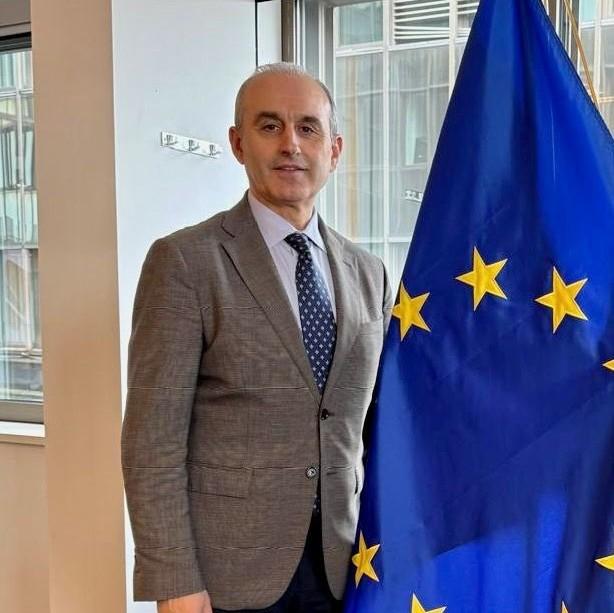 Chair - Dr Alin Bodescu
Col. (ret) Alin Bodescu, Ph.D. is assistant professor with the Land Forces Academy, Sibiu, Romania. He served with the European Union Military Staff (EUMS) as Action Officer (2011–2016), where he coordinated EU military training and education, co-drafted the EU CSDP training policy-related documents, and developed internal training programmes for EUMS personnel. Between 2017 and 2021, he was seconded as Training Manager with the European Security and Defence College, where he led the development of the Sectoral Qualifications Framework for the Military Officer Profession (SQF-MILOF) and the Advanced Modular Training Course. His operational experience includes a tour in Irak, with Italian Joint Task Force (2004) and a mission with the USCENTCOM HQ (2006), contributing to planning and coordination efforts of the multinational coalition.
 ESDC Coordinator - Stanislava Kraynova
Stanislava Kraynova is a Bulgarian civilian expert with many years of experience in Training, Education, Project Management, and Resilience through Civil Preparedness, seconded to ESDC by the Bulgarian Ministry of Defence since March 2023. She is handling an extensive ESDC course portfolio in the fields of Common Foreign and Security Policy (CFSP) and Common Security and Defence Policy (CSDP), by implementing project plans, managing project stakeholders and the related budget. She actively contributes to the co-ordination, organisation and implementation of the Pre-deployment training for CSDP missions and operations. She is in lead of the implementation of the Sectoral Qualification Framework for the military profession, being also the coordinator of the Executive Group (SQF-MILEG).