About the configuration
As recognised in the EU Joint Communication “A New Outlook on the Climate and Security Nexus” (JC, 2023), its Progress Report (2025), and the EU Policy on Training for CSDP (2024), advancing capacity, knowledge and expertise on the intersection of climate change, environment, security, peace and defence is necessary for the EU – and CSDP – to respond efficiently and effectively to current challenges as well as constantly adapt to existing and emerging security challenges.
Responding to the training gap identified by the Council, the Climate Change, Environment Security, and Defence Configuration (CCESD) was established in 2024 as a platform to strengthen EU capacity to anticipate and respond to climate- and environment related security risks.
Under the auspices of the European Security and Defence College (ESDC), the CCESD coordinates and pools capacity-related resources from across the EU, member states, and its partners. This structure allows the configuration to systematically develop and provide needs-based training and education necessary to effectively address the impact of climate and environment on peace, security and defence. It provides a framework to address training gaps, strengthen institutional capacity, and promotes synergies with stakeholders at multilateral, regional, and bilateral levels to tackle the nexus of climate change, environment, security, and defence.
In doing so, the CCESD contributes to the EU's wider preparedness and resilience agenda and helps operationalise the Climate and Security Nexus in EU External Action and beyond.
Mandate and Mission
The CCESD aims to strengthen climate literacy across the board and develop the specialised expertise at EU, national, and partner level required to ensure effective climate preparedness and resilience, support conflict prevention, and contribute to sustainable peace, in line with the EU's integrated approach to peace, security, and defence:
According to the Joint Communication (2023, p. 15) the configuration’s objective is “to develop the required expertise at EU and national level, including for example environmental law and crime experts, environmental engineers, and climate-related security risk analysts. This will also enable the EU to gradually develop a pool of (certified) experts that Member States could make available to CSDP missions/operations in addition to their work in national ministries."
The urgency for action and relevance of the CCESD has been reiterated by the Council in 2026, recalling
"the need to further strengthen EU capacity to respond to climate- and environment related security risks by continuing to integrate climate and environmental aspects into foreign, security and defence policy, including peacebuilding, mediation, conflict-prevention, and CSDP missions, in line with the full implementation of the 2023 Joint Communication on the Climate-Security Nexus" (Council Conclusions on EU energy and climate diplomacy (8054/26; para 36)).

Conceptual foundations, training approach, and guiding principles
Conceptual foundations
- A comprehensive approach to climate security: The CCESD is grounded in a comprehensive understanding of the Climate Security Nexus as defined by the JC 2023: climate security "refers to the impacts of both climate change and environmental degradation, including biodiversity loss and pollution, on peace, security and defence" (ibid., p. 1). The CCESD recognises the interdependence of all nine planetary boundaries and uses this framework to assess rising security risks driven by human pressure on Earth’s critical life-support systems.
- From threat multiplier to direct threat: The CCESD embraces the shift in viewing climate change not merely as a 'threat multiplier,' but as a key driver of conflict and a profound threat to human security in its own right.
- A pathway approach to conflict: The CCESD utilises climate security pathways, as coined by the Stockholm International Peace Research Institute (SIPRI), to untangle how climate change and environmental stress can affect conflict and stabilisation efforts: Climate change acts as a catalyst rather than a direct cause of violent conflict, worsening existing social, economic, political, and environmental pressures to fuel instability, insecurity and conflict. Grounded in this reality, the CCESD helps operationalise the nexus across EU External Action..
- Climate change and the environment as an opportunity for peacebuilding: The CCESD recognises that shared challenges related to climate change and the environment can serve as constructive entry points for peacebuilding and regional cooperation. Recognising and addressing the linkages between climate, peace, and security are considered instrumental in relation to both, preventing conflict and sustaining peace.
- Human security: The CCESD acknowledges the complex, cross-cutting, and global, yet context-specific nature of climate change and environmental degradation. To address these challenges, it uses human security as a framework to support comprehensive and prevention-oriented approaches that strengthen the protection and empowerment of all people. By utilising a holistic approach – based on the seven dimensions of human security: economic security, food security, health security, environmental security, personal security, community security, and political security – CCESD ensures that its trainings are informed by contexts, structures, and people's vulnerabilities; and are further based on integration, a whole-society approach; localisation; prevention and resilience.
Training approach
These conceptual understandings inform the CCESD's approach to capacity building in a holistic and systemic manner. Responding to the needs of different training audiences, raise awareness and develop the necessary specialised skills to address the impact of climate and environment on peace, security and defence, the CCESD follows a twin-track approach, that combines effective mainstreaming and climate security-focused training.
- Track 1: Mainstreaming
CCESD supports the advancement of the topic through mainstreaming of environment and climate topics into training and education including developing messages of consensus (scientific quality-based content), joint learning, good practice sharing, coordination, and complementarity with other international stakeholders.
Climate Security Mainstreaming Guidance Note: The CCESD has developed this guidance note to help training providers and course directors integrate climate and environmental considerations into peace, security, and/or defence courses, where climate- and environment-related thematics are not the primary subject. It provides a rationale for why these matter, a practical checklist to guide integration, and guidance on framing, sourcing materials, and measuring impact and utility.
- Track 2: Climate security-focused training
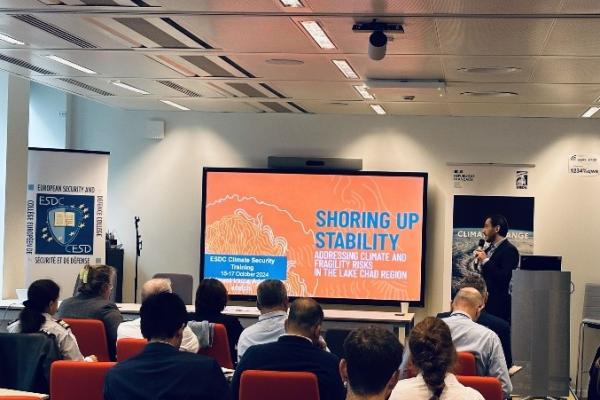
The CCESD seeks to address training gaps and promote quality, coherence and complementarity of training, education and related activities that address the climate, environment and security and defence nexus. The CCESD develops expertise and capacities on the climate-security nexus, as well as on related specialised and technical topics through in-depth trainings and seminars. The training and educational products range from topical e-Learnings, guidance notes, technical seminars as well as multi-day courses.
Trainings under this track serve to deepen participants' understanding of the climate security nexus (at various levels: basic, intermediate, advanced) and/or help build expertise in certain specialisation areas (environmental crime; environmental management for CSDP; hydrodiplomacy; energy security), in line with the training requirement analyses, political priorities, and training gaps identified in the field.
- ^ See further: https://councilonstrategicrisks.org/2025/10/28/from-hybrid-threats-to-stability-multipliers-meeting-the-climate-security-moment/ (accessed: 10 November 2026).
- ^ Mobjörk, M., Krampe, F., & Tarif, K. (2020, November). Pathways of climate insecurity: Guidance for policymakers (SIPRI Policy Brief). Stockholm International Peace Research Institute. https://www.sipri.org/publications/2020/sipri-policy-briefs/pathways-cl…
- ^ See Center for Climate and Security, 2023, Briefer No. 38 (accessed: 10 November 2026).
- ^ See: McDonald M., 2013, Discourses of Climate Security (accessed: 10 November 2026).
- ^ See: https://www.un.org/humansecurity/what-is-human-security/ (accessed: 10 November 2026).
Guiding principles
In ensuring a high-quality, resilient and sustainable EU climate security training offer, the CCESD seeks to ensure that its initiatives:
- are needs-based and tailored, responding to clearly identified needs and adapted to the specific contexts, priorities and profiles of target audiences.
- are modular and complementary, allowing different training offers to build on and reinforce one another, while providing a coherent and comprehensive learning pathway.
- are innovative and interactive, drawing on participatory methodologies, practical exercises and collaborative approaches to encourage active engagement and knowledge exchange.
- promote inclusive, gender-sensitive and accessible learning environments, ensuring that diverse perspectives and experiences are reflected and that all participants can contribute meaningfully.
- Foster collaborative and peer-to-peer learning, facilitating the exchange of experiences, good practices and lessons learned, and strengthening networks and cooperation among participants and relevant stakeholders.
Governance structure and team
Overview
The Climate Change, Environment, Security and Defence configuration (CCESD) operates through regular plenary sessions, thematic sub-groups and task forces to implement a modular, needs-based training programme.
As of December 2026, the platform brings together 28 training providers and 26 additional partners from government ministries, police forces, and civil society as well as the EU and International Organisations.
Plenary and sub-group participation is open to all CCESD members. Additionally, members can grant observer status to non-members of the CCESD.
CCESD Sub-groups
While the CCESD Plenary supports the development of training that fosters basic and advanced understanding of the climate and environmental security nexus, the CCESD consist of four thematic sub-groups, each dedicated to strengthening training, expertise and capacities in a specific topical area.
SG 01: Environmental Crime
The group focuses on developing courses and building capacities on environmental crimes, such as illegal logging and exploitation of natural resources, pollution and other forms of environmental harm. The group seeks to strengthen prevention, analysis, governance and rule of law related to this area of organised crime.

SG 02: Environmental Management
The group seeks to create awareness and capacities on environmental management in civilian and military missions and operations. This covers topics such as resource efficiency, identification, mitigation and management of environmental risks for more sustainable operational contexts.
SG 03: Climate, Peace, Security
This group covers all activities and courses under the broader climate, peace and security nexus and integration across conflict prevention, mediation, foreign and security policy, as well as the wider CFSP. It creates awareness around environmental peacebuilding, hydrodiplomacy, and linkages to human security.
SG 04: Climate-Energy-Defence Nexus
This group addresses the links between climate change, energy security and defence. It develops trainings focusing on strengthening energy security within the EU and CSDP mission contexts. The group also seeks to create awareness and develop capacities to prevent and respond to the impacts of climate change on security, defence operational capabilities and critical infrastructures.
Forms of cooperation
- Network and partnership
CCESD seeks to liaise and cooperate with relevant stakeholders at multilateral, regional and bilateral levels to address the climate change, environment, security, and defence nexus through close partnerships and reinforce institutional capacity among the EU, its Member States and partners. CCESD further seeks close cooperation with civil society, including local actors, research bodies, and think tanks.
- Membership
CCESD is open to relevant national training actors and experts from EU Member States, as well as to EU bodies, institutions and agencies, CSDP missions and operations, and partners as defined in its Terms of Reference.
- How to engage
There are multiple opportunities to engage as a CCESD Network Members, Associate Network partners or observers. Engagement is possible in one or more of the sub-groups, which meet on a monthly basis to address identified training and capacity gaps in the related thematic area.
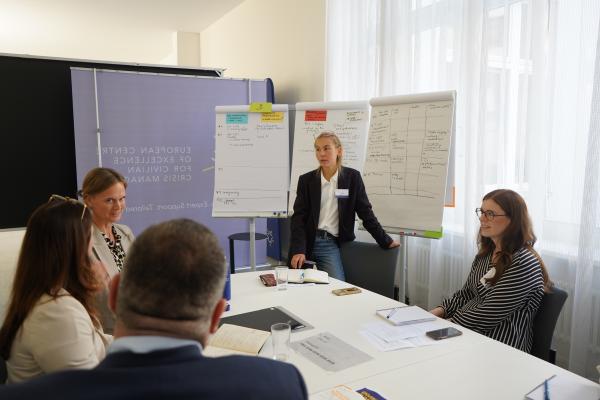
Members may contribute to the development and revision of course curricula, the planning and delivery of courses, as lecturers or thematic experts contributing to the development of course material such as scenarios, table-top exercises or e-learnings.
Chair and Configuration Support
 Chair Monika Psenner
Monika Psenner serves as the first Chairperson of the CCESD and is Head of Capacity Development at the Austrian Centre for Peace, where she provides strategic and operational oversight of the organisation's comprehensive training portfolio. She is also the founder and director of Aidvance.net, a social enterprise promoting ethical practices in international aid and development. With over 15 years at SOS Children’s Villages International, she has worked extensively with local associations across Africa.
Monika holds degrees in language studies and international business (University of Innsbruck), and a Master’s in International Affairs from the Fletcher School of Law and Diplomacy at Tufts University. She is also a trained crisis and contingency manager. ESDC Coordinator Esther Breffka
Esther Breffka is seconded from the Zentrum für Internationale Friedenseinsätze (ZIF) to the ESDC, where she serves as the ESDC’s Climate Security Coordinator. In this capacity, she develops and manages the CCESD, organises and leads related training courses, seminars, and conferences, and fosters partnerships in the field both within the EU and internationally. Esther holds a Bachelor’s in International Relations (TU Dresden) and a Global Master in Development Practice (Trinity College Dublin), both awarded with first-class honours. Her expertise includes human rights, sustainable development, gender, and law, with experience across Europe and Africa.
Facts and figures
 20+courses since the start of the configuration
 +600participants since 2018
 40%of participants were women
 57%civilian participants
 23%military participants
 8%participants working in law enforcement
 12%participants from diplomatic services